3 W. Main St, Suite 103
Irvington, NY 10533

Contact info
844.X-Caliber
(212.220.7040)
Newsletter Signup
Join Thousands of Readers Who Subscribe to Our Content.

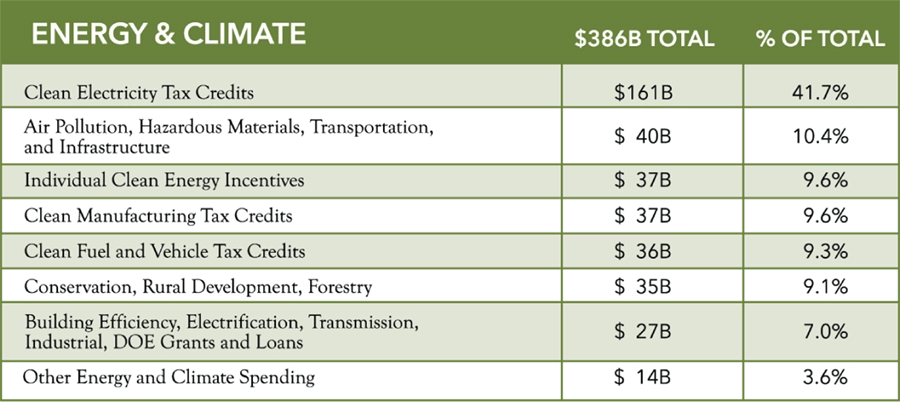
Source: https://www.crfb.org/blogs/whats-inflation-reduction-act
 To lower inflation, the major strategy Congress and the administration used was to target the reduction of long-term energy costs by increasing sustainable energy product, reducing carbon emissions, and offering incentives for energy-efficient building improvements—which is where the multifamily opportunity rests. The emphasis on buildings comes from their global responsibility for 37% of carbon emissions, when including those from production of such materials as steel, glass, aluminum, and bricks, as the United Nations Environment Programme has reported.iii Buildings are responsible for 34% of energy demand, according to CBRE Group.iv
Knowing such programs and opportunities exist is important but not enough. Multifamily investors, owners, and developers working across the U.S. will benefit from understanding how aspects of the IRA can help maximize many tax advantages and incentives.
Many of the tax incentives and funds will support domestic solar panel production, wind turbines, electric vehicle (EV) charging equipment, and more. These may sound industrial, but they can often be used in connection with multifamily properties. The chart below shows a breakout of the IRA by industry, according to an analysis by McKinsey & Company.v
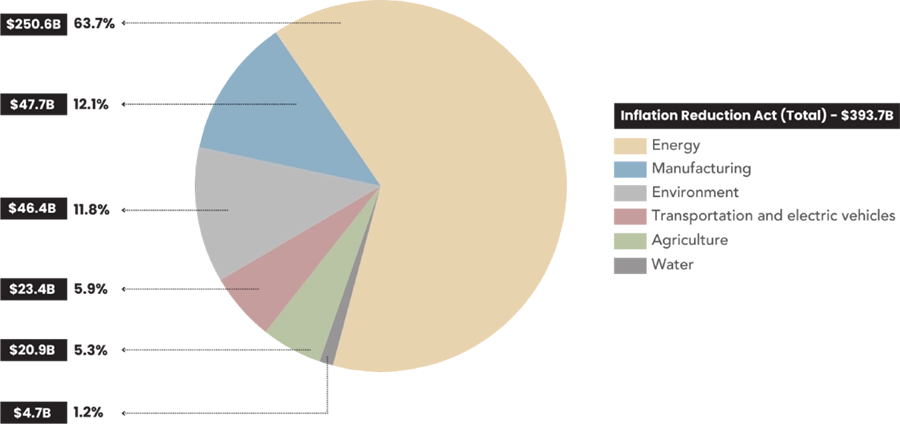
The funds are available through a mix of tax incentives, grants, and loan guarantees.
Tax incentives are directed motivation to encourage private investment in both clean energy technologies and energy-efficient building improvements.
Roughly $216 billion of the tax incentives are available to directly offset business taxes. Under the right conditions, a company can reduce its tax payments or sell the tax credits to another party. Because the IRA makes tax credits easier to monetize than in the past, it’s likely that companies will be able to use these credits as collateral for project development and construction. Sold tax credits reduce an owner’s net equity investment in a given project, enhancing returns on invested equity.
There are other financial benefits to property improvements and clean technology. They reduce operating costs. In the case of solar power or other energy generation sold into the electrical grid or to tenants, they can directly enhance revenue. The additional cash flow might take a project not yet ready for a construction or bridge loan and provide the capital to enable financing.
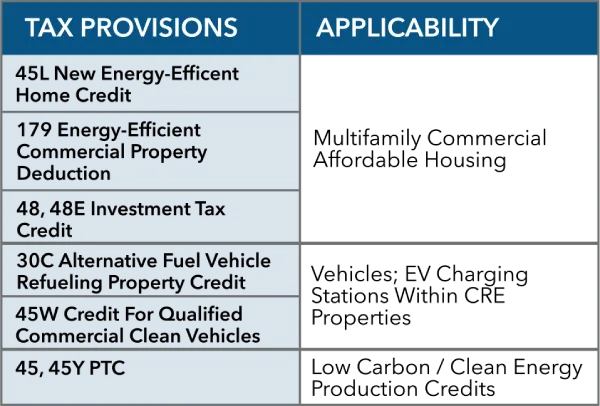
Below is a table of some of the most applicable tax incentives for multifamily owners, developers, and investors, focusing on those that apply to projects started in 2023 or later. Following the table are brief descriptions of each incentive, but you are well advised to check with your legal, accounting, and construction advisors before trying to claim any of them, as there can be many complexities and detailed requirements.




Today’s challenges for multifamily are striking and complex. Structuring deals has become difficult with high interest rates, interest rate caps, and other factors complicating financing. However, some of the above tax programs could potentially help offset enough costs to make projects possible.
For more information, get in touch with us at info@x-caliber.com.
i. Estimated Budgetary Effects of Public Law 117-169, to Provide for Reconciliation Pursuant to Title II of S. Con. Res. 14, Congressional Budget Office, September 7, 2022
ii. CBO Scores IRA with $238 Billion of Deficit Reduction, Committee for a Responsible Federal Budget, September 7, 2022
iii. 2022 Global Status Report for Buildings and Construction, UN Environment Programme, November 9, 2022
iv. Decarbonizing Commercial Real Estate, CBRE, undated
v. The Inflation Reduction Act: Here’s what’s in it, McKinsey & Company, October 24, 2022
vi. Elective Pay and Transferability, Internal Revenue Service, October 6, 2023
vii. Energy efficient commercial buildings deduction, Internal Revenue Service, October 6, 2023
viii. Manufacturers for Qualified Commercial Clean Vehicle Credit, Internal Revenue Service, September 26, 2023