Senior Housing
Staffing and wage pressure. Tight labor pools and higher wage expectations continue to weigh on operating margins, especially in higher-acuity settings that rely on licensed nursing and clinical staff.

Senior Housing
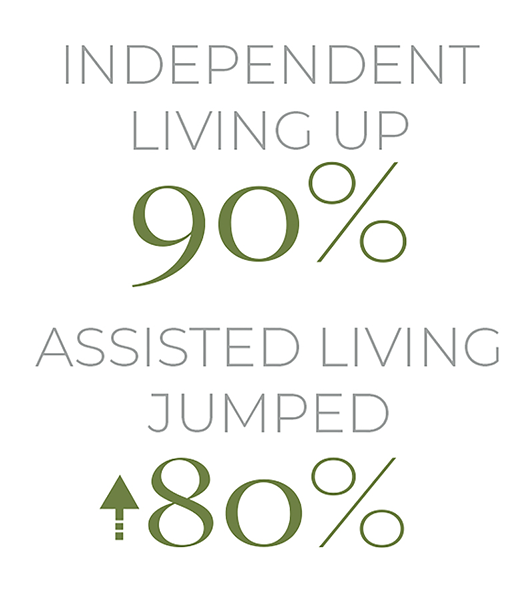
Senior housing looks very different than it did a few years ago. Occupancy has climbed back into the high-80% range, with independent living above 90% in many markets, according to the National Investment Center for Seniors Housing & Care. New construction, meanwhile, sits near historic lows as higher rates and construction costs keep many ground-up projects on hold. That mix—stronger demand and limited new supply—gives well-run communities a clearer path to stable cash flow, but it also raises the stakes for capital planning, staffing, and reinvestment in aging buildings.
At the same time, demographics are starting to exert real pressure. The 80+ population is set to grow meaningfully over the next decade, and today’s construction pace will not keep up with projected demand. Operators that can maintain quality, manage labor and expenses, and keep properties physically competitive are positioned to benefit from this structural tailwind. Underinvested or highly leveraged assets likely will find it harder to keep up.
In this environment, how you finance a senior housing asset matters as much as whether you finance it at all. In 2025, which saw some big developments in senior housing financing, HUD introduced Express Lane processing for low-risk Section 232/223(f) loans, raised the 232/223(f) repair threshold, lowered DSCR and increased LTV/LTC for certain FHA multifamily programs, and moved to a flat 0.25% mortgage insurance premium (MIP) for FHA multifamily across the board while phasing out green MIP categories.
These changes are about getting low‑risk Section 232/223(f) healthcare loans through processing faster so they can close more quickly and free up HUD’s financing capacity. For eligible borrowers, this can open more paths to fund needed capital plans, better match debt to business plans, and manage execution risk in a market where long-term, reliable financing is a competitive advantage.
Senior housing spans a continuum of care, from lifestyle-oriented communities to facilities with clinical services:
Each model carries different staffing needs, regulatory requirements, margins, and capital plans. The right financing structure depends on where a property sits along this continuum and how the operator manages care, reimbursement, and occupancy risk.
The sector entered 2025 with real momentum. Across the 31 primary markets that NIC tracks, senior housing occupancy reached roughly 88.7% in the third quarter of 2025, marking the seventeenth consecutive quarter of improvement. Independent living surpassed 90% occupancy, while assisted living climbed into the high-80% range.
New construction, however, remains constrained. Senior housing starts sit near 0.2% of existing inventory, one of the lowest levels on record, and overall inventory growth is well below pre-pandemic norms. The combination of steady demand and limited new supply has tightened fundamentals, supported rent growth, and given lenders more confidence in well-stabilized properties.
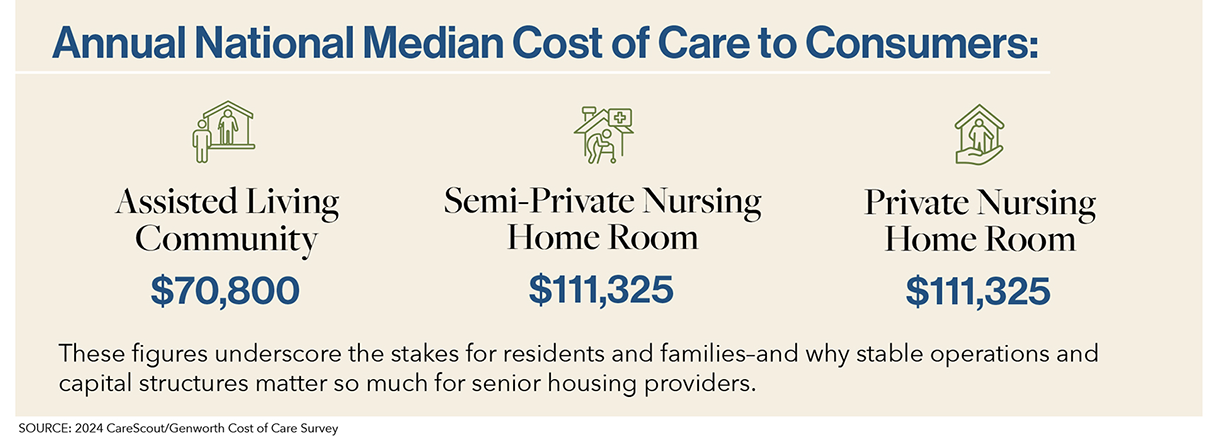
Costs and care needs still shape margins. Construction inputs remain elevated, interest rates sit above the prior decade’s lows, and labor continues to drive operating decisions. Operators face wage pressure and staffing constraints, even as occupancy improves. The cost of care to consumers also continues to rise, putting a premium on efficient operations and thoughtful capital planning.
Senior housing is shifting from “recovering” to “repositioning.” Operators are no longer asking whether demand will return—they’re deciding which assets to reinvest in, which to reconfigure, and where to grow as the care needs and expectations of older adults’ change. Here’s where the pressure is building fastest and where thoughtful capital and operating decisions can turn that pressure into durable advantage.
Taken together, these forces point to a decade where demand should remain durable, while operational discipline and access to reliable long-term capital will separate resilient communities from those that struggle.

In a market with limited new inventory and improving occupancy, capital structure becomes a strategic choice rather than only a closing detail. For many owners and operators, the core considerations include:
HUD’s Section 232/223(f) program remains a central tool for eligible properties. It offers:

While specific requirements are detailed in HUD guidance and lender term sheets, Express Lane generally focuses on:
Within that framework, HUD sets minimum debt service coverage ratios of 2.0x for skilled nursing components and 1.6x for non-skilled portions, based on unadjusted T-12 NOI. These thresholds reinforce the focus on stable, lower-risk assets while giving qualifying borrowers a clearer path to priority review placement.
Actual processing times still depend on deal complexity, completeness of the application, and broader HUD workload.
X-Caliber recently provided capital for an underwrite-ready skilled nursing refinance that qualified for Express Lane. The execution did more than compress the calendar; it changed the borrower’s risk profile. By moving from Application Submission to Firm Commitment in just 8 days—and from submission to closing in 71 days—the operator locked in long-term, fixed-rate, non-recourse financing before further rate volatility could erode proceeds or disrupt plans. The structure refinanced a maturing obligation, funded replacement reserves, and supported targeted upgrades to patient rooms, therapy areas, and equipment—all within a single 232/223(f) loan.
For the borrower, that meant predictable debt service and a clearer capital plan. Instead of spending months in a prolonged approval process, management could redirect time and attention to resident care, staff retention, and executing on the facility’s clinical and operational goals. The deal illustrates how, for qualifying assets, Express Lane can translate underwriting strength and preparation into real-world benefits: faster access to capital, greater execution certainty, and the ability to reinvest in care environments without unnecessary delay.
Beyond Express Lane, HUD has updated several program features that directly affect senior housing owners and operators.
Historically, the 232/223(f) program limited the number of repairs, replacements, and improvements that could be financed within a 223(f) execution. Hard costs could not exceed 15% of the project’s value after completion without triggering “substantial rehabilitation” treatment, which meant pursuing a different, more complex structure.
In 2025, HUD issued new guidance that:
For owners and operators, the practical effect is more room to execute heavier capital plans—roofs, mechanical systems, life-safety upgrades, and comprehensive unit renovations—within a 232/223(f) refinance, if the project stays within the new 25% threshold and meets HUD’s other criteria. That can simplify financing structures and reduce execution risk for many mid-scale rehab plans.
For independent living or age-restricted communities that use FHA multifamily programs rather than healthcare programs, HUD’s 2025 multifamily updates are also important:
These adjustments modestly increase potential proceeds and create more sizing flexibility while preserving program discipline around leverage and coverage. For age-restricted or senior-focused multifamily communities that qualify under these programs, the changes can help more deals pencil in a higher-cost environment.
In the fall of 2025, HUD finalized a uniform 0.25% annual mortgage insurance premium (MIP) for all FHA multifamily insurance programs. Previously, MIPs ranged widely higher for standard market-rate deals and lower for certain affordable and green categories.
Under the new structure:
For independent living and age-restricted communities financed through FHA multifamily programs, the combination of lower MIP and more flexible DSCR/LTV standards can improve long-term economics and increase project viability. As always, individual outcomes depend on each asset’s underwriting, market positioning, and capital stack.
HUD also eliminated the separate Green and Energy Efficient MIP category for Section 232 healthcare facilities. Going forward:
For senior housing borrowers, the takeaway is straightforward: Green design and energy efficiency can still be good business decisions, but they no longer carry a distinct MIP discount under the 232 program. Cost savings will come from operational efficiencies rather than an explicit MIP incentive.
The combination of stronger occupancy, limited new inventory, and 2025 HUD updates creates a clearer playbook for senior housing owners and operators who want to align capital with strategy.
HUD program benefits don’t eliminate risk. Rate volatility, reimbursement changes, regulatory shifts, and labor costs can still pressure margins. Senior housing remains an operating business first and a real estate investment second.
HUD’s framework helps manage financing risk through:
But the business still rests on operations and compliance. Facilities must maintain quality ratings, manage survey risk, handle reimbursement accurately, and invest in staff and the physical facility. Express Lane and other 2025 changes can enhance execution certainty, not replace the need for strong fundamentals.
Express Lane is best viewed as a process improvement, not a different product. It rewards readiness and lower risk with earlier review, while leaving underwriting standards intact. Sponsors should treat it as one tool for managing timeline uncertainty when their deals already meet the criteria.