Precision Financing For Multifamily New Construction

Strategic Considerations for Developers and Investors

Knowledge Is Power – Understanding Your Financing Options

Multifamily investors planning new construction projects have access to a range of financing solutions designed to support development from the ground up. This whitepaper examines two of the most commonly utilized options for multifamily new construction: the Federal Housing Administration’s FHA 221(d)(4) program and conventional bank financing. By understanding the structure, benefits, and considerations of each, investors can make informed decisions aligned with their project goals and capital strategy.

FHA 221(d)(4) Program: Financing For New Construction And Substantial Rehabilitation

Financing for New Construction and Substantial Rehabilitation

The FHA 221(d)(4) program, administered by the U.S. Department of Housing and Urban Development (HUD), provides non-recourse, fixed-rate financing for the construction or substantial rehabilitation of multifamily properties. Designed to encourage long-term investment in housing, this program offers competitive leverage, extended amortization periods, and built-in protections that make it a cornerstone financing tool for developers seeking stability and predictability throughout the construction and operating phases.

Program highlights:

  • The program offers flexible, high-proceeds financing for properties with five or more units. It offers a fixed rate that is locked when the loan is initially endorsed and carries through the full amortizing term, which is up to 40 years plus the construction period.
  • It allows for higher loantocost (LTC) ratios – up to 85% for marketrate projects and up to 90% for affordable projects, including construction and soft costs.
  • Adherence to DavisBacon prevailing wage is standard for the FHA 221(d)(4) program.
  • The program provides a standardized underwriting process under HUD’s MAP framework.
  • It provides nonrecourse financing, which means the borrower is not personally liable for the loan (subject to standard carveouts).

Loans are fully assumable with HUD approval. A small HUD assumption/TPA fee applies (0.05% of the original insured mortgage amount). HUD recently set a uniform MIP of 0.25% for FHA multifamily programs (effective for new or amended applications on or after Oct. 1, 2025).

If market rates decline, HUD’s Interest Rate Reduction (IRR) process can lower the note rate on current FHAinsured loans. IRR does not extend the loan term or allow cashout, and existing prepayment provisions still apply.

Sponsors must have site control at the time of the HUD initial construction loan closing (e.g., a purchase contract or ground lease). Eligible land acquisition can be included in the HUD budget; 221(d)(4) is not used once construction draws have begun or construction has been completed.

  • Underwriting floors: Minimum DSCR is typically 1.15x for marketrate and 1.11x for affordable projects.
  • Crossprogram update: HUD recently aligned 223(f) sizing with these floors, with maximum proceeds up to 87% and 90% LTV/LTC, respectively, on eligible refinance/purchase deals.
  • Conversion mechanics: At 100% construction completion and subsequent cost certification, the loan proceeds to final endorsement and the permanent phase—no separate occupancy or NOI test is required.

Conventional Bank Lending

Tradition Financing Through Banks and Credit Unions

Conventional bank lending refers to obtaining a loan from a private lender, such as a bank or credit union.

Program highlights:

  • Traditional bank lending usually provides lower proceeds.
  • Conventional loans often feature miniperm structures with terms up to 5 or 7 years.
  • Typical loantocost (LTC) ratios are 55–65%.
  • Higher equity requirements are common.
  • Traditional bank lending is typically recourse and requires personal guarantees from developers.
  • Conventional loans typically close in 120–150 days.

Recap

Here is a recap of the two products and their basic offerings.
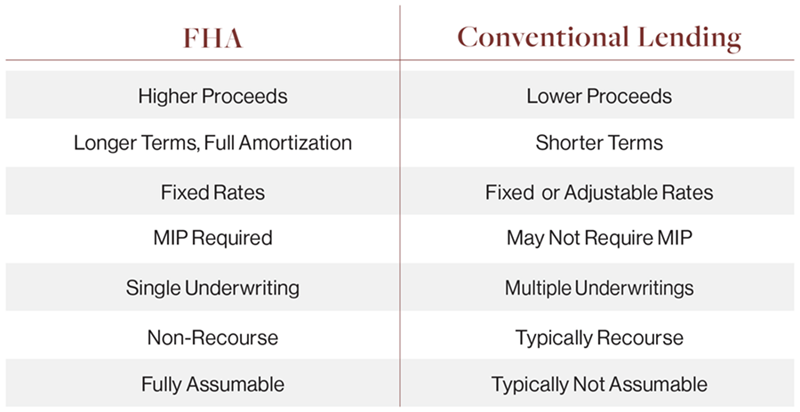
The FHA 221(d)(4) and conventional lending programs have different features for new multifamily construction. Developers should weigh program requirements, timelines, and costs to select the option that best fits the project.

Financing Multifamily Pre-Development

Bridging Early-Stage Projects to FHA 221(d)(4)

Early-stage multifamily developments often require flexible capital to move from concept to construction. Pre-development financing helps bridge this gap, positioning projects for a seamless transition into long-term FHA 221(d)(4) funding.

  • Purpose: Fund land acquisition, entitlements, and pre-construction activities.
  • Structure: Short-term, interest-only loans structured for FHA 221(d)(4) take-out.
  • Leverage: Up to ~60% LTC/LTV; typically full recourse during early stages.
  • Exit: Smooth conversion to long-term, non-recourse HUD-insured construction financing.
(212) 220-7040