
October Multifamily Market Update: The New Reality: Improving Fundamentals, Cooling Capital
There is no doubt that apartment fundamentals are improving. And yet the capital markets are not—an unusual paradox reflecting the unique dynamics of 2026.
Typically when occupancy and rents show signs of heating up, capital follows. Instead, capital is cooling for reasons unrelated to supply/demand fundamentals. To state the obvious: It’s all about rates. The Fed’s latest rate hike, plus the potential for another hike, creates real math problems for multifamily investors and developers already struggling to make the math work. Cap rates are now very similar to 10-year Treasury yields in the low 5s, which disincentivizes capital from betting on apartments.
Will rates keep going up from here, or settle at a new normal? Will cap rates follow suit, or will they hold steady as owners choose to hold on rather than sell low? Will lenders continue to pump dollars into refinancings, allowing those owners to hold on longer and therefore keep valuations fairly stable?
In short: There’s a lot of uncertainty around the multifamily capital markets, and investors hate uncertainty.
But here’s what we do know: Fundamentals are indeed improving. But do hear me on this because a lot of doomers cynically conflate “recovering” with “recovered.”
Apartments are not “back.” They’ve not rebounded. But apartments are clearly trending in the right direction this year following backtracking from late 2022 through the winter of 2025-26. Here are the latest stats through Q3.
Supply
Year-to-date through September, apartment deliveries are at the lowest levels in seven years, with 231k units completing, according to RealPage. That’s not nothing, but it’s a huge drop from the peak of 435k units set in 2024’s first nine months.
Supply has been the biggest headwind to apartment NOI these past few years, surging to the highest levels in 40+ years, but that peak is now in the rearview mirror. We’re entering a new era of more moderate supply – levels that historically have been manageable.
Demand
As CoStar’s head of multifamily research, Grant Montgomery, told me on a recent podcast, demand has been the big surprise of 2026, with absorption likely to top all major data providers’ forecasts. Year-to-date absorption tops 400k units according to CoStar, putting 2026 on track to record the third-highest annual absorption in modern history. RealPage shows a moderately lower 345k units, but that’s still well above concurrent supply and still one of the biggest numbers ever in that dataset.
In short: There are demand headwinds, yes, and yet the absorption numbers remain impressively strong. And with demand topping supply, that means we finally have some vacancy improvement.
Vacancy
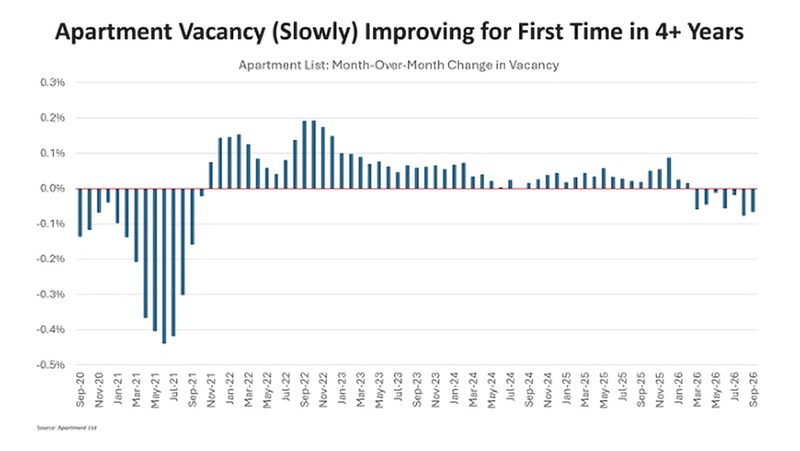
CoStar shows vacancy going down for the first time in nearly six years. Apartment List shows a similar trend. Vacancy rates have been steadily trending down in every month since March of this year, according to Apartment List, reversing a supply-driven multi-year uptick.
U.S. apartments are certainly not back to normal on vacancy (no mission accomplished banner to fly here), but we’ve clearly hit an inflection point this year.
Rents
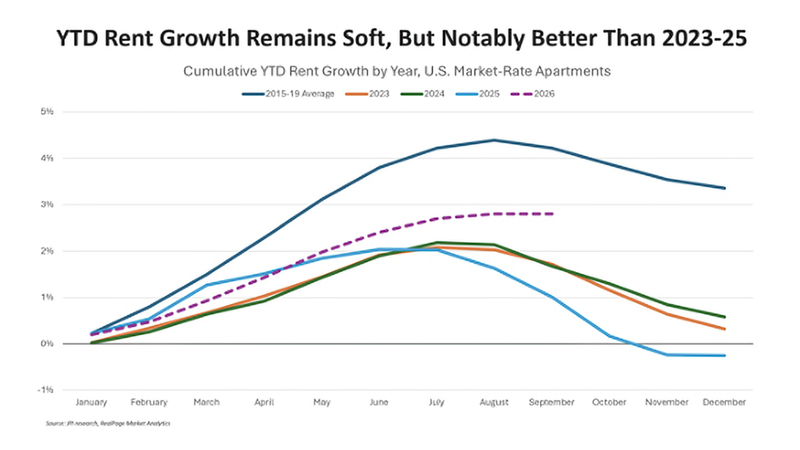
The same is true of rents. This chart shows year-to-date rent growth. We’re at 2.8% YTD according to RealPage. A little less according to CoStar.
And this chart really tells the clearest story of where we are. It shows 2026 is the best year in four years, much better than 2023, 2024, and 2025, when supply was surging and rents falling. But 2026 is still below the pre-COVID trend lines, and by a pretty good margin. So, again, 2026 is better, but not hot by any means. Not even normal yet. But showing momentum for the first time in 4-5 years.
Year-over-year, effective rent growth measures 1.5%, according to RealPage. Due to base effects (the potential for more normal monthly rent numbers in Q4 to replace really bad numbers at the same time last year), we could end the year around 2%. I had forecasted low 2s, so we’re on track to be around that mark, maybe a hair less.
Rents by Market
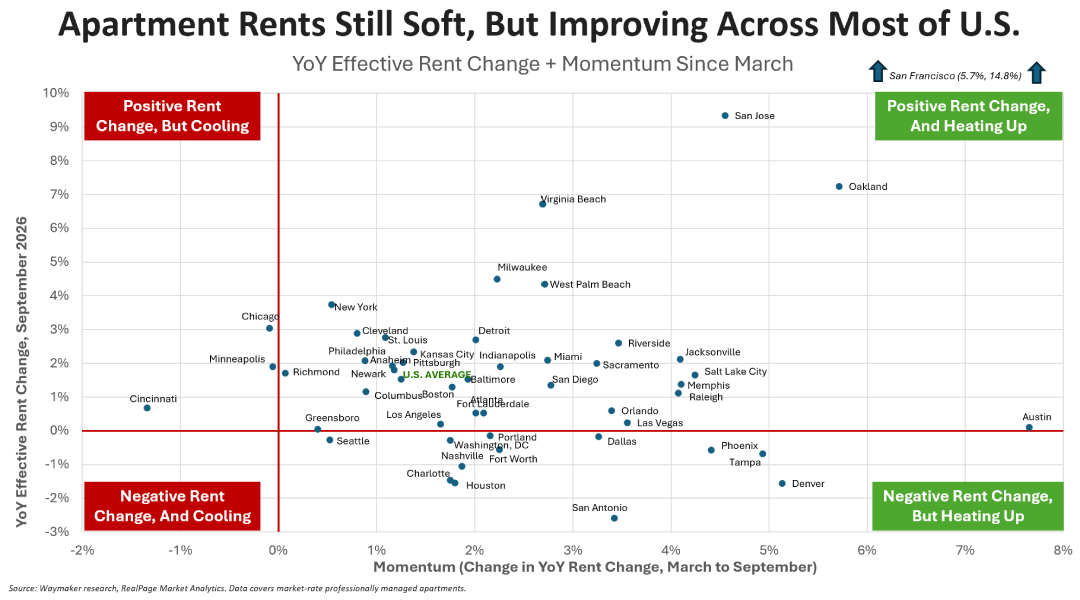
Low-supplied markets continue to dominate the rent growth leaderboard. But the dynamics are shifting fast. This chart shows current year-over-year rent change (y-axis) versus momentum since March (x-axis).
Current rent growth leaders remain mostly the usual suspects, led by San Francisco, which is cropped off this chart due to being such a significant outlier, followed by San Jose and Oakland. Virginia Beach, Milwaukee and West Palm Beach rank high, as well, while Midwest and Northeast markets remain mostly steady in the 2-4% range.
But it’s the momentum story that is most interesting right now. Look at the big shifts happening this year in Austin (which has turned positive – albeit barely – for the first time in nearly four years), Denver, Tampa, Phoenix, Salt Lake City, Jacksonville, Orlando, Dallas, San Antonio, etc. Some of those are still cutting rents, but at the mildest pace in 3+ years, and could soon turn.
Don’t be the type who waits until it’s sunshine and rainbows again before acknowledging that the clouds are moving. Yes, rents are still soft in most of the Sun Belt and Mountain states. But it doesn’t take a genius to point out 3-4% rent growth when 3-4% rent growth is already happening. The real story right now isn’t that these markets are “back,” but that they’re trending upward again following backpedaling from 2022-25. That doesn’t necessarily mean rent growth will hit 4%, and that momentum could stall out, but clearly 2026 has been an inflection point thus far – aligning with the supply slowdown.
What Does the Future Hold?
There’s only one known variable: There will be a lot less supply in the years to come than what we had from 2023-25. We don’t know how much demand will be out there, and economic sputtering could certainly soften that demand. But, so far, demand has held up better than most groups expected. Even if demand slows down to more typical levels, it won’t take much to outpace supply and keep vacancy improving.
But the real unknown is around capital markets. Gone are the expectations going into the year that transaction volumes would pick up in the second half of this year. The Fed took away any hope for that. Uncertainty around rates means capital markets remain largely on ice.
This sets up a dynamic that most of us have never seen in our careers as we head into 2027: improving fundamentals, cooling capital.