3 W. Main St, Suite 103
Irvington, NY 10533

Contact info
844.X-Caliber
(212.220.7040)
Newsletter Signup
Join Thousands of Readers Who Subscribe to Our Content.

This month’s HUD Insights starts with major news that impacts your projects: HUD has lowered the mortgage insurance premium for all multifamily loans. These are the latest policy updates from Washington, D.C., that are shaping the future of multifamily housing.
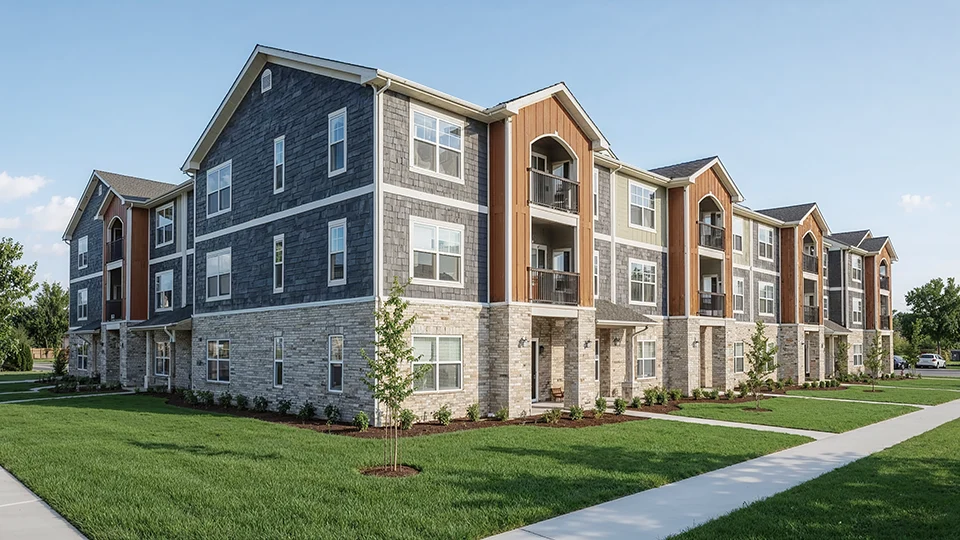
The story: The Department of Housing and Urban Development (HUD) has finalized a rule that simplifies and reduces financing costs for FHA Multifamily Insurance Programs. Effective Oct. 1, all new or amended applications will carry a uniform 0.25% mortgage insurance premium (MIP).
“This is a significant step in streamlining FHA multifamily financing. A flat 0.25% MIP makes modeling easier and reduces costs for developers and operators.”
– Megan Booth, Vice President of Commercial Real Estate Finance Policy, Mortgage Bankers Association
The follow-up: Borrowers should revisit financial models to reflect the new premium and confirm whether any green certifications or reporting requirements once tied to MIP reductions are still needed. The change is aligned with broader federal priorities to expand housing supply and reduce cost pressures.
The bottom line: A single, lower MIP creates cost savings and simplifies underwriting for multifamily borrowers, making project feasibility stronger in today’s high-cost environment.
The story: Financing costs for HUD 221(d)(4) and 223(f) loans saw a significant drop after the Federal Reserve lowered its benchmark interest rate by 25 basis points earlier this month. How low will rates go? That’s still an open question: Housing analysts are watching movement in the 10-year Treasury, which indicates longer-term trends.
“The fact that the Federal Reserve is taking its time, it’s being balanced and measured in how it adjusts its rates—I think that gives confidence to investors all around the world.”
– David Kelly, chief global strategist at JPMorgan Asset Management
The follow-up: Interest rates may get additional downward pressure this year, as the Fed signaled a potential for two more rate cuts by the end of 2025.
The bottom line: The lending environment is becoming particularly favorable for HUD multifamily borrowers. Just keep an eye out for indications of broader economic performance.
The story: The Department of Labor (DOL) has raised the threshold at which split wages are determined under the Davis-Bacon Act for federally funded multifamily projects. This helps manage costs for developers, who also are grappling with increasing prices for construction materials.
“The cost of labor has dogged construction projects for some time, and this change gives multifamily developers meaningful financial relief and a clearer path forward for new starts. But there’s more that can be done.”
– MBA’s Megan Booth
The follow-up: Booth says MBA continues to meet with DOL to discuss further changes to the Davis-Bacon Act to address the timing of the wage determination, the definition of a residential structure, and the improper use of split wages.
The bottom line: Multifamily developers can forecast lower expenses for contractor compensation, leaving more room for project improvements.
The story: The Office of Management and Budget (OMB) has posted a notice saying that it is reviewing a “final rule” submitted by HUD to change the standard of disparate impact under the Fair Housing Act. The content of the rule change has not been published to the Federal Register, but housing advocates expect it to take the teeth out of disparate impact liability.
“It is the policy of the United States to eliminate the use of disparate-impact liability in all contexts to the maximum degree possible.”
– Executive order issued in April
The follow-up: The National Low-Income Housing Coalition says it expects the final disparate impact rule to mirror a 2020 rule under the first Trump administration that took the teeth out of disparate impact.
The bottom line: Housing providers are still responsible for maintaining equitable business practices under fair housing law.
The story: The OMB recently republished its spring agenda for HUD and FHA, indicating the Trump administration’s housing priorities through the rest of the year. Topline items on the docket include:
The follow-up: Some of these priorities, such as the FFRMS rescission, have already been greenlit and are simply waiting to be implemented at the appropriate time. The remainder of the Trump administration’s housing agenda likely faces few hurdles to enactment.
The bottom line: Look to see robust movement around housing policy on Capitol Hill through the rest of the year.