Unlocking Supply: How HUD Financing Updates Shift the Multifamily Landscape
A fact-based guide to what changed, why it matters, and how the math on multifamily deals can look different going forward.

A fact-based guide to what changed, why it matters, and how the math on multifamily deals can look different going forward.
Connect with our team to discuss financing solutions and execution designed to support your project’s long-term success as HUD policy continues to evolve.
That combination changes what sponsors need from permanent financing. The priority shifts from “maximum proceeds at any cost” to proceeds you can underwrite with confidence, terms you can model for the long run, and execution rules that don’t force repeated re-trades late in the process. In other words: the market puts more pressure on the inputs that drive debt service, coverage, and overall feasibility.
HUD made these changes in 2025 for a simple reason: too many otherwise workable multifamily deals were getting squeezed by higher rates, higher costs, and underwriting standards that no longer matched the market. The goal was to make FHA more usable for affordable, workforce, middle-income, and market-rate housing by easing key constraints, improving competitiveness, and helping more new construction, rehab, and preservation deals move forward.
HUD has also signaled that more positive multifamily updates could follow in 2026, with draft guidance pointing to additional changes to its Multifamily Accelerated Processing (MAP) framework as well as underwriting updates still in the pipeline.
The 2025 updates have changed the inputs inside FHA sizing. Three of the most important updates for developers and owners:
Together, these moves make FHA execution simpler to model and more competitive in a market that rewards predictability.
“When the market tightens, small variables aren’t small anymore,” says Adlana Buck, FHA Chief Underwriter at X-Caliber. “The HUD changes matter because they reduce friction in the math—especially recurring costs and sizing constraints—at a time when deals don’t have much cushion.”
What you’ll find in this whitepaper:

If you want one change that impacts almost every FHA multifamily conversation, it’s this: HUD moved to a standard 25-basis-point MIP across the board.
“There were a few programs that were as high as 95 basis points, so to remove 70 basis points of yield from that is pretty meaningful,” says David Borsos, Vice President of Capital Markets at the National Multifamily Housing Council.
MIP is not a one-time fee you forget after closing. It’s a recurring cost that sits in the annual debt burden for the life of the loan. When you lower that line item, you change the relationship between:
“Sponsors don’t argue with the idea of long-term FHA capital. They argue with uncertainty in the long-term math,” Buck explains. “A flat 25-basis-point MIP helps because it removes a variable that used to swing comparisons and coverage more than most people realize.”
-ADLANA BUCK
FHA Chief Underwriter at X-Caliber
HUD’s shift to a flat MIP also eliminated the need for older tiering structures, including the prior “Green MIP” categories that were designed as incentives. That doesn’t mean energy standards disappear. It means HUD no longer uses MIP tiers as the main incentive lever, with MIP already at the statutory minimum.
Bottom line: If you model FHA economics, this is the cleanest input change HUD could make, and it shows up immediately.
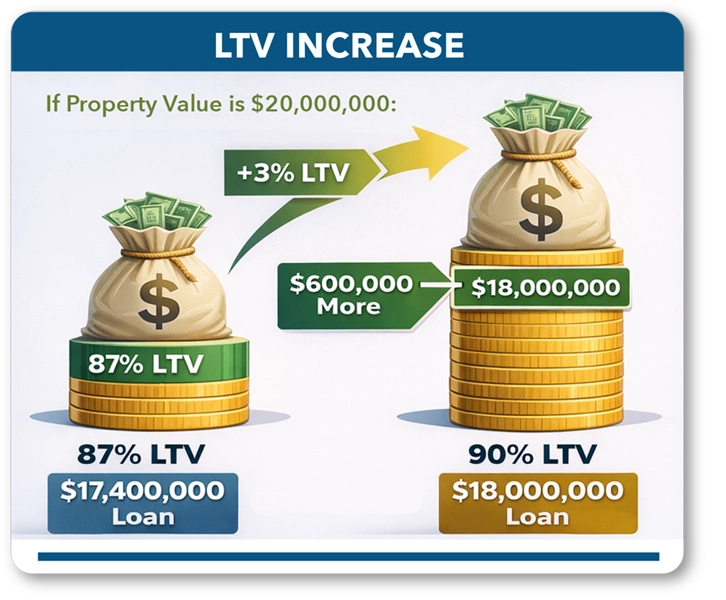
Mortgagee Letter 2025-03 updated debt service coverage (DSCR) and loan-to-value/loan-to-cost (LTV/LTC) thresholds for many FHA multifamily executions. The direction of travel is simple: HUD eased debt service constraints for many market-rate and affordable deals.
For many market-rate deals, HUD moved to:
For affordable housing, HUD moved to:
For properties with 90% or more rental assistance, the key thresholds stayed at:
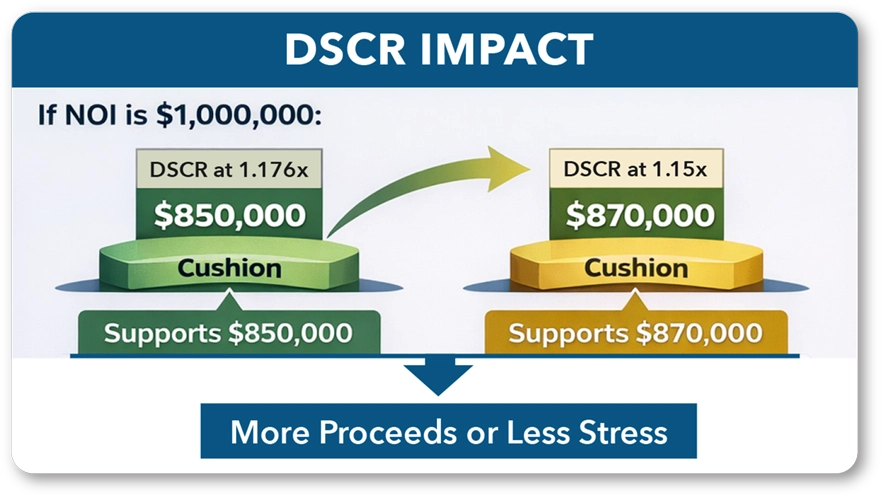
Many deals don’t move forward because a key sizing limit shows up earlier than expected:
By relaxing DSCR and LTV/LTC in combination, HUD made it more likely that a deal can clear sizing tests without “hero assumptions.”
“When a deal struggles to clear sizing, the issue often isn’t the concept, it’s the margin,” Buck says. “Small changes in DSCR or leverage can decide whether the sponsor can keep scope intact or has to value-engineer something that changes the project.”
HUD introduced a Middle Income Housing concept, then updated and clarified it in Mortgagee Letter 2026-01.
HUD’s reasoning is practical: “middle income” has meant different things in different places, and HUD wanted a clearer framework for underwriting and compliance. HUD notes that many definitions target households roughly in the 60%–120% area median income (AMI) range, with variations in high-cost markets.
For Middle Income Housing under 221(d)(4), HUD set:
And HUD tied eligibility to the existence of a state or local middle-income program, including a recorded use restriction and monitoring framework.
A 50% restricted-unit requirement can influence the revenue mix and compliance process, so sponsors typically test whether the project still supports the plan under realistic rent and expense assumptions. They also look at monitoring requirements and whether the local or state program framework makes the restriction practical to implement.
HUD’s program descriptions give the clean baseline:
Why the changes feel different for development vs. stabilized deals
For 221(d)(4) deals (new construction):
For 223(f) deals (existing assets):
As HUD expands the set of deals that can qualify on economics, the sponsor’s ability to deliver a complete, consistent package helps ensure certainty of execution and adherence to key milestones that prevent delays.
MAP is designed around lender-prepared submissions and HUD review standards. The MAP Guide and Mortgagee Letters point toward the same idea: standardized underwriting expectations, complete applications, and disciplined sequencing.
A “HUD-ready” approach typically includes:
“The fastest way to slow down a HUD execution is to let basic documentation drift,” Buck says. “When the file tells a clean story, including property, sponsor, scope, and sources, review becomes more predictable.”



Even with MIP simplified, design and energy decisions still hit the underwriting model through cost (envelope, systems, materials, schedule) and operations (utility assumptions and long-term expense behavior).
The International Energy Conservation Code and ASHRAE 90.1 standards continue to shape building requirements through local adoption. What changed is HUD’s approach to incentivizing energy efficiency through MIP tiers: once MIP moved to a universal minimum, those older categories no longer functioned as intended.
Positive takeaway: the MIP change simplified the economics, while energy performance still matters because it affects long-term operations.
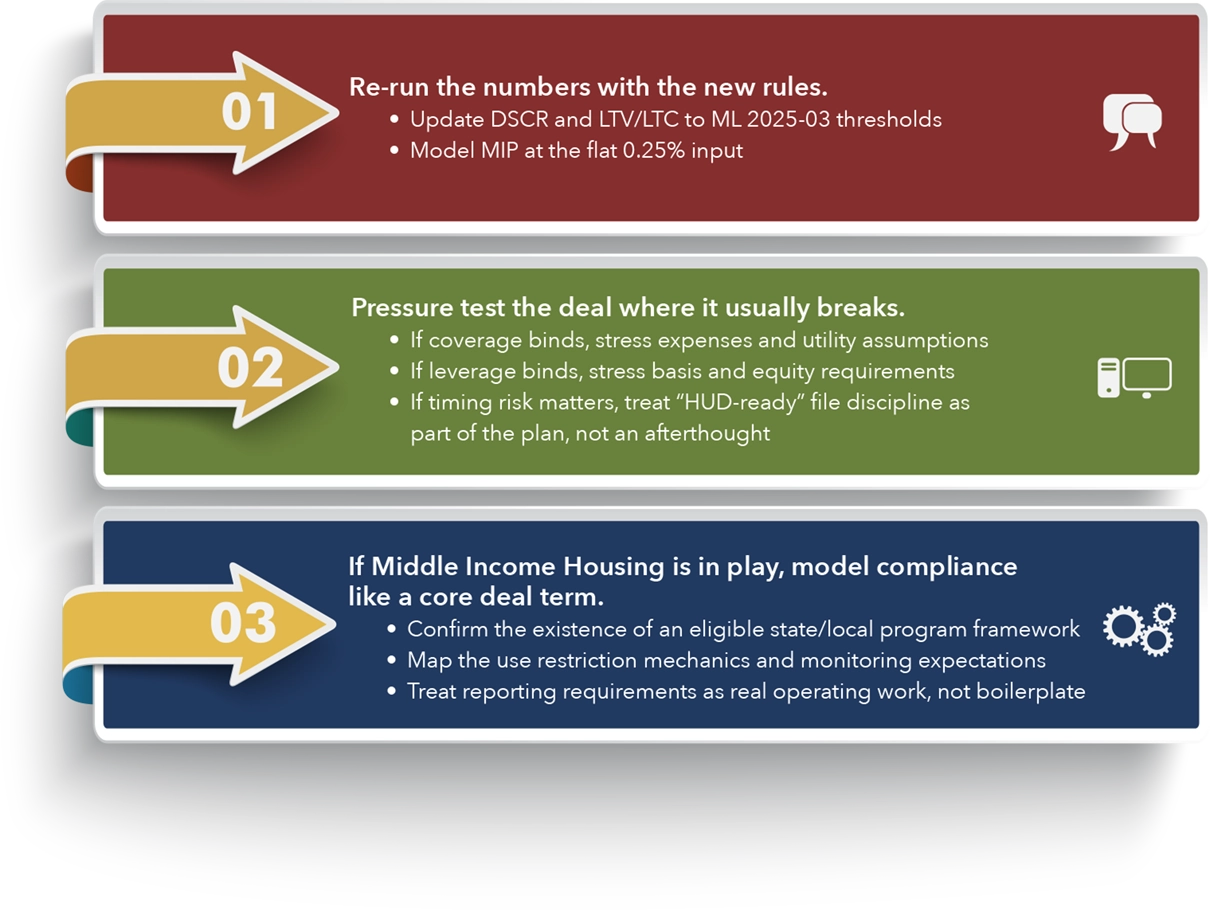
Here’s a sponsor-friendly way to use HUD’s updates without turning this into a “what should I do” guide.
HUD’s recent updates improve the “inside-the-program” math—recurring cost (flat 0.25% MIP) and loan sizing (DSCR and leverage). In higher-cost markets, though, the binding constraint can shift from underwriting ratios to statutory loan limits or to capital stack capacity. Two current legislative proposals on Capitol Hill would address those constraints in ways that could increase the practical reach of HUD’s recent changes if they become law.
The Housing for the 21st Century Act focuses on raising statutory maximum loan limits for FHA multifamily mortgage insurance programs and updating how those limits adjust over time using a more specific inflation index tied to development costs. The ROAD to Housing Act covers similar ground by calling for analysis of whether current multifamily loan limits remain appropriate and describing a pathway for HUD to increase certain loan limits through rulemaking within specified bounds.
Together, the throughline is straightforward: If loan limits rise or become easier to adjust, more projects, particularly in high-cost markets, could fully benefit from HUD’s eased DSCR and leverage standards rather than reaching a loan-limit ceiling first.
The ROAD to Housing Act discussion also includes a separate capital-availability lever: raising the cap on banks’ public welfare investments (PWIs). If bank PWI capacity expands, it could support credit availability for affordable housing-related investment activity. That can matter for transactions where the capital stack, not just the permanent debt sizing, drives feasibility.
The sponsor impact: HUD made underwriting and recurring-cost inputs more favorable. These proposals could determine whether those improvements translate into higher executable proceeds on deals where loan limits or complementary capital sources become the first constraint.
HUD’s recent updates changed the math in practical ways: lower recurring cost, more flexible sizing, and a clearer path for qualifying middle-income deals. For borrowers, that means FHA can now work on more transactions that might not have cleared the box under the old standards. And this story may not be finished.
HUD has already signaled more multifamily policy updates through draft 2026 guidance, so borrowers should expect the program to keep moving in a direction that supports execution certainty, housing production, and more workable deal structures. Additional tailwinds may come if Congress expands FHA multifamily loan limits or gives HUD more room to adjust them.
The bottom line: HUD’s changes reflect what the market has been signaling: sponsors need long-term capital that fits real operating risk. Expect more emphasis on borrower experience, documentation, asset condition, and ongoing compliance—even as sizing becomes more flexible. The best approach is to treat FHA as a program-driven execution from day one: align the capital stack, the scope, and the reporting expectations before you get hooked by the potential proceeds.
___________________________________________________________________________________
David Borsos serves as Vice President of Capital Markets at the National Multifamily Housing Council (NMHC), where he leads the organization’s multifamily finance policy work on federal legislative and regulatory issues, including FHA policy and capital access for apartment owners and developers.
Adlana Buck is FHA Chief Underwriter at X-Caliber, leading underwriting for all MAP and LEAN executions and overseeing credit strategy, transaction structuring, and lender compliance across the firm’s FHA multifamily and healthcare platforms.
Department of Housing and Urban Development. (2021). Multifamily Accelerated Processing (MAP) Guide.
https://www.ncsha.org/wp-content/uploads/MAP-Guide-2021.pdf
LeadingAge. (2024, November). HUD Seeks to Serve Middle Income.
https://leadingage.org/hud-seeks-to-serve-middle-income/
National Association of Home Builders. (2025, September). HUD cuts all multifamily mortgage insurance premiums to 25 basis points.
https://www.nahb.org/blog/2025/09/hud-cuts-all-multifamily-mortgage-insurance-premiums
X-Caliber. (2025, September). HUD Sets Single 0.25% MIP for All Multifamily Programs.
https://x-calibercap.com/hud-insights/hud-insights-september-2025/#item_1
CohnReznick. (2025, February). HUD updates FHA multifamily rules to boost supply, affordability.
https://www.cohnreznick.com/insights/multifamily-housing-programs
Nixon Peabody. (2025, January). HUD adopts relaxed loan sizing standards for FHA-insured loans.
https://www.nixonpeabody.com/insights/alerts/2025/01/14/hud-adopts-relaxed-loan-sizing-standards-for-fha-insured-loans
NewPoint. (2025, January). HUD announces changes to DSCR and LTC/LTV requirements.
https://newpoint.com/news/hud-announces-changes-dscr-and-ltcltv-requirements
Department of Housing and Urban Development. (2025). HUD Secretary Scott Turner moves to eliminate green housing mandate.
https://www.hud.gov/news/hud-no-25-084
Department of Housing and Urban Development. (2025). Mortgagee Letter 2025-03.
https://www.hud.gov/sites/dfiles/OCHCO/documents/2025-03hsgml.pdf
Department of Housing and Urban Development. (2026). Mortgagee Letter 2026-01.
https://www.hud.gov/sites/dfiles/hudclips/documents/2026-01hsgml.pdf
Janover. What Is the HUD MAP Guide?
https://www.hud.loans/hud-loans-blog/what-is-the-hud-map-guide/